

Submitted for Your Disapproval: The Bullshit Zone
When the president uses the world’s stage to rage, lie, and gloat

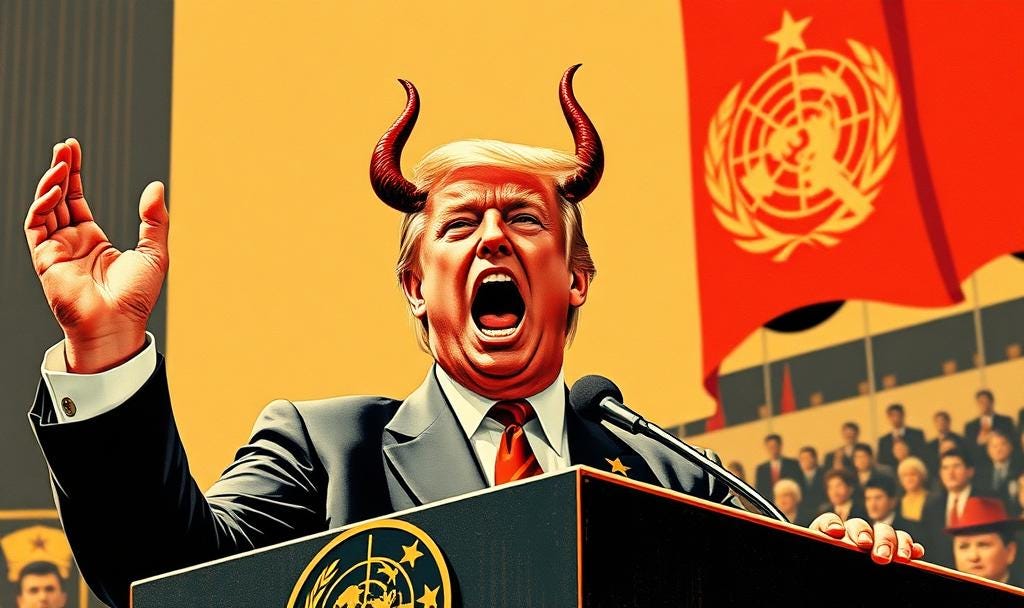
Yesterday, Donald Trump stepped up to the marble podium at the United Nations General Assembly and delivered what may be remembered as one of the most destabilizing addresses ever given by an American president. It was not diplomacy, nor was it strategy. It was a forty-minute rejection of cooperation and restraint, a performance that replaced vision with grievance.
This was not simply unorthodox rhetoric. It was dangerous.
What he said and why it matters
The address began with a blunt denial of reality. Trump dismissed climate change as a scam, discarding decades of evidence and collaboration with a single phrase. In doing so, he sent a message to the world: the United States, the largest historical emitter of greenhouse gases, would not only retreat from global leadership but also actively undermine it.
The speech then turned toward Europe when Trump warned leaders that their nations were “being destroyed” by immigration, declaring that their “countries are going to hell.” The words were an attempt to recast migration as an existential threat rather than a complex human reality. Immigrants were stripped of identity and humanity, reduced to symbols of decline.
Trump’s narrative of history was no less stark. He claimed to have ended “seven unendable wars,” presenting himself as the lone figure who could impose peace where no one else had succeeded. In this retelling, diplomacy became irrelevant, allies disappeared from view, and history bent entirely to the will of one man. It was a familiar pattern: the authoritarian as singular peacemaker, standing above the failures of institutions.
Finally, the speech turned inward, toward the institution itself when Trump derided the United Nations as a hollow body incapable of meaningful action. Technical mishaps like a malfunctioning teleprompter and a stalled escalator were seized upon as metaphors for incompetence, as though the machinery of international order itself were broken. In his telling, the very concept of global cooperation was a farce.
The speech, taken as a whole, was not a roadmap for policy but a manifesto of withdrawal: a United States estranged from its allies, disdainful of science, and openly contemptuous of the institutions designed to prevent catastrophe.
The bigger danger
Beneath the spectacle lay a worldview that should trouble every nation. Trump portrayed cooperation as weakness, compromise as betrayal, and truth as negotiable. Allies were painted as burdens, immigrants as invaders, scientists as liars, and international institutions as little more than theater.
This posture erodes the fragile structures that hold the international order together. When an American president uses the world’s most prominent diplomatic stage to deny science, inflame xenophobia, and belittle the institutions of peace, he does more than speak to his base. He signals to other leaders that the bonds of cooperation can be broken without consequence.
The ripple effects are profound. Climate agreements falter. Multilateral negotiations collapse. Autocrats find validation in his contempt. In a world already strained by conflict, disinformation, and environmental crisis, the unraveling of cooperative norms is not merely reckless — it is perilous.
Why this moment matters
Trump’s address to the United Nations was not a speech in the traditional sense. It was a warning not of the dangers he claimed to see, but of the dangers he himself represents. A world in which the United States abandons cooperation and elevates grievance over reason is a world that edges closer to chaos.
Yesterday’s performance will not be remembered for its policy content. It will be remembered as a turning point: the moment the American presidency, once seen as a steward of global order, openly mocked the very idea of shared responsibility.